
If you’ve been researching shockwave therapy for heel pain, plantar fasciitis, or a stubborn Achilles injury, you’ve probably run into two terms that sound almost identical: focused shockwave and radial shockwave.
They’re often lumped together under the umbrella of “Extracorporeal Shockwave Therapy” (ESWT), and many clinics offer one or the other. But they’re not the same technology, and the difference has a real impact on your results.
At Collective Footcare, we’re one of the few clinics in the Hamilton area (or Ontario for that matter!) that offers both. That’s intentional. Different conditions respond better to different types of shockwave, and having access to both means we can match the treatment to the problem, rather than the other way around.
Here’s what you need to know.
What Is Shockwave Therapy, Exactly?
Shockwave therapy uses high-energy acoustic waves to stimulate healing in soft tissue — tendons, fascia, muscle, and bone. It’s been used in medicine for decades (originally to break up kidney stones) and has become a go-to treatment for chronic musculoskeletal conditions that haven’t responded to rest, stretching, or orthotics alone.
The therapy works by delivering pulses of pressure into the injured tissue. Those pulses trigger a cascade of healing responses: increased blood flow, stimulation of stem cells, the breakdown of scar tissue and calcifications, and a reduction in pain signalling.
Where focused and radial shockwave differ is in how that energy is delivered.
Radial Shockwave: Broad and Shallow
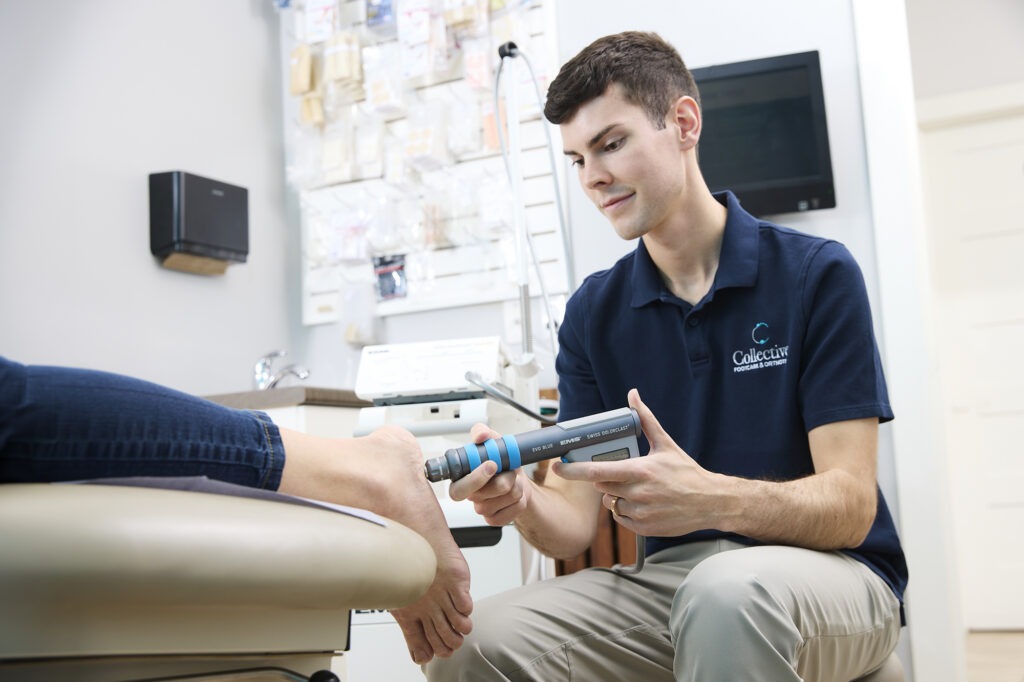
Radial shockwave is generated by a pneumatic system where essentially, a piston inside the applicator strikes the skin and sends a pressure wave outward into the tissue.
Key characteristics:
- Energy disperses in a wide, cone-shaped pattern. The wave is strongest right at the surface of the skin and loses intensity as it travels deeper.
- Shallow penetration. Most of the therapeutic effect happens within the first 3–4 cm of tissue.
- Covers a larger treatment area. This makes it efficient for treating broad zones of tension or pain.
- Feels like firm, rapid tapping. Most patients tolerate it well without anaesthetic.
Radial shockwave is well-suited for:
- General plantar fasciitis (especially cases with diffuse arch pain)
- Achilles tendinopathy
- Shin splints
- Superficial muscular tension and trigger points
- Broad soft-tissue conditions
Focused Shockwave: Deep and Precise
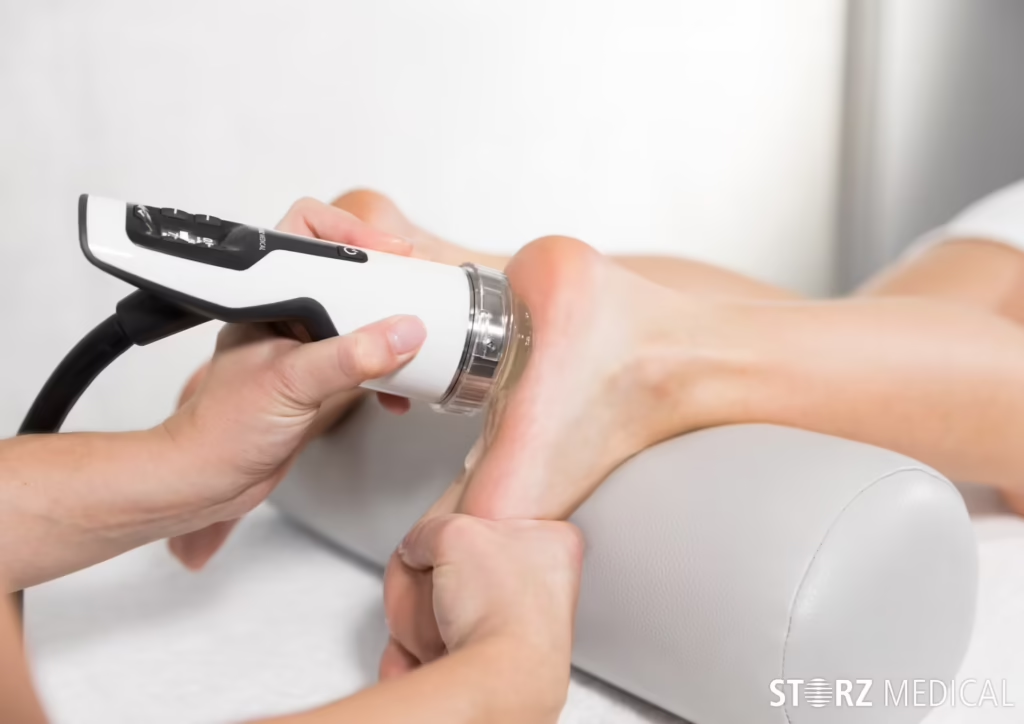
Focused shockwave works on a completely different principle. Rather than dispersing outward, the energy is generated and then concentrated to a precise focal point at a chosen depth below the skin, up to several centimetres — using an electromagnetic or electrohydraulic source.
Key characteristics:
- Energy converges at a controllable depth. The wave is weakest at the surface and strongest at the target.
- Pinpoint accuracy. We can direct the energy to a specific structure, such as the enthesis of the plantar fascia or a deep calcification.
- Higher energy density. Focused waves can deliver more therapeutic power to the target tissue without irritating surrounding structures.
- Generally considered the more clinically studied modality for certain chronic tendon and bone conditions.
Focused shockwave is well-suited for:
- Chronic, stubborn plantar fasciitis that hasn’t responded to other treatments
- Heel spurs and deep insertional heel pain
- Insertional Achilles tendinopathy
- Bone stress injuries and delayed bone healing
- Morton’s neuroma
- Deep, localized tendon problems
At Collective Footcare, our focused shockwave is delivered using the Storz Duolith SD1 — one of the most well-regarded focused shockwave devices in clinical practice worldwide.
Side-by-Side Comparison
| Feature | Radial Shockwave | Focused Shockwave |
|---|---|---|
| Energy pattern | Disperses outward | Converges at a focal point |
| Depth of effect | Shallow (up to ~3–4 cm) | Deep (controllable, several cm) |
| Intensity at surface | Highest | Lowest |
| Intensity at target | Decreases with depth | Highest at target depth |
| Treatment area | Broad | Pinpoint |
| Best for | Superficial, widespread soft-tissue conditions | Deep, localized, or chronic conditions |
| Sensation | Firm tapping | Deeper, more targeted pressure |
So Which One Do You Need?
The honest answer: it depends on your diagnosis, how long you’ve had the problem, how deep the affected tissue is, and what you’ve already tried.
A few examples of how we think about it in clinic:
- New-onset plantar fasciitis with general arch pain? Radial is often a great first-line choice.
- Plantar fasciitis that’s been stubborn for 6+ months, with a heel spur visible on imaging? Focused shockwave is usually the better tool.
- Achilles tendinopathy in the mid-portion of the tendon? Radial often works well.
- Insertional Achilles tendinopathy right at the heel bone? Focused tends to get better results.
- A patient who has “tried shockwave before” without success? Often, they’ve only had radial. Adding focused can change the outcome entirely.
In many cases, the best approach is a combination, using radial to address broader soft-tissue dysfunction and focused to target the deep, chronic pain generator.
Why It Matters That a Clinic Offers Both
Most clinics in our area offer one type of shockwave. That’s not a knock on them, the equipment is expensive, and radial units are far more common because they’re more affordable.
But if your clinic only has a radial device, your treatment plan has to fit that device. When we can choose between focused and radial (or combine them), your treatment plan fits you.
That’s why we invested in the Storz Duolith SD1 alongside our radial unit. Between the two, we can treat a much wider range of conditions and tailor each session to what your tissue actually needs.
Ready to Find Out If Shockwave Is Right for You?
If you’ve been dealing with heel pain, plantar fasciitis, Achilles problems, or another chronic foot or ankle issue, a shockwave consultation is a good next step. We’ll assess your condition, talk through your history, and recommend whether focused, radial, or a combination is the best fit.
Benjamin Wilkinson, BSc Pod (Hons), is a Registered Chiropodist and the owner of Collective Footcare and Orthotics in Hamilton, Ontario. The clinic offers both focused and radial shockwave therapy, along with custom orthotics, laser nail therapy, therapeutic injections, and minor surgical procedures.